From data acquisition to understanding what is really happening on the plant floor.
Industry already generates enormous amounts of data.
ortion of the processing to take place locally, within the factory itself.
For computer vision applications, for example, image analysis can be performed directly on the device without the images having to leave the plant.
This approach brings artificial intelligence closer to the actual process and enables the platform to work continuously with information generated by day-to-day operations.
AI That Understands the Reality of the Factory
One of Synapse's key differentiators is how it uses knowledge specific to each plant.
A conventional system presents information. Synapse is designed to interpret that information in the context of the process.
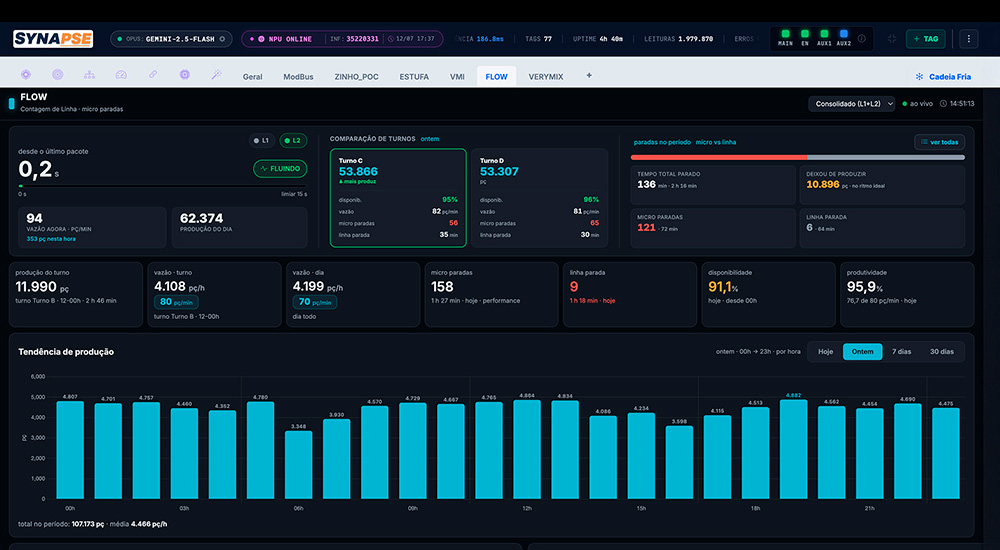
The platform can work with real-time data, historical operating records, production indicators, availability metrics, and other information relevant to plant performance.
Using this combined information, an AI agent turns the data into clearer, more useful interpretations for industrial teams.
Instead of presenting managers with a screen containing dozens or hundreds of indicators to analyze, the goal is to deliver insights closer to what an experienced professional would provide:
What happened during the shift?
When did the process behavior begin to change?
Where did downtime or performance losses occur?
Which information needs to be checked?
Is there any behavior that deviates from historical patterns?
The goal is to reduce the time between receiving information and understanding what it means.
A SCADA System Displays the Data. Synapse Interprets It.
This is one of the key differences between Synapse and a traditional supervisory control system.
A SCADA system is essential to industrial operations. It collects and displays process information so that personnel can monitor operating conditions.
Synapse adds a new layer: the ability to analyze that information and turn it into meaningful interpretations.
This changes how teams interact with data.
Rather than requiring personnel to navigate multiple indicators to determine what happened, artificial intelligence can perform an initial analysis and present its findings in more natural language.
It is the difference between receiving a spreadsheet full of numbers and receiving an analysis explaining what changed, when it changed, and where further investigation may be worthwhile.
Engineering Knowledge That Stays in the Plant
There is another important challenge in industry: knowledge.
Many plants rely on experienced professionals who have an in-depth understanding of specific equipment and processes. They know how to recognize abnormal behavior, identify early signs of potential problems, and interpret situations that are not always documented in manuals.
This expertise is extremely valuable.
But what happens when that professional changes shifts, goes on vacation, or leaves the company?
That knowledge should not leave with them.
Synapse was designed to help address this challenge. The platform can incorporate process information, operating histories, and technical knowledge specific to the plant.
This allows the AI to be configured to interpret data according to the conditions and requirements of that environment.
When provided with process knowledge, it can support process-focused analysis. When given maintenance records and related information, it can help interpret conditions from a maintenance perspective.
The goal is not to replace the engineer.
It is to make engineering knowledge available around the clock to the people working in the plant.
Intelligence That Keeps Working Even Without Internet Access
Another important aspect of Synapse's architecture is local processing.
Data acquisition and process measurements take place within the plant itself. This means that important production, historical, and availability data do not depend exclusively on an external connection to continue being recorded.
Even if the internet connection goes down, the factory continues to be monitored.
The platform also includes an AI layer that uses cloud-based models for certain language-related functions. When connectivity is available, these capabilities can be used to turn analyses into reports and more natural-language interpretations.
When the connection is unavailable, the platform can continue working with locally processed data and calculations, clearly indicating when an interpretation has been generated without access to the cloud-based model.
This approach combines local processing, connectivity, and transparency.
Computer Vision on the Production Line
Synapse can also incorporate computer vision capabilities.
In this context, cameras can be used to analyze products and processes directly on the production line, while AI identifies predefined characteristics.
The analysis takes place locally, on the device itself.
This opens up possibilities for applications such as quality inspection, production counting, and pattern recognition, among other requirements specific to each industrial process.
The key advantage is the integration of visual information with other operational data.
Images are no longer isolated sources of information. They become part of the broader context the platform uses to understand the process.
A Modular Platform for Different Needs
Not every industrial operation needs to begin with a complex artificial intelligence project.
That is why Synapse was designed with a modular architecture.
Implementation can start with a specific problem that directly affects operations, such as:
Production counting.
Downtime monitoring.
OEE and efficiency indicators.
Quality analysis.
Computer vision.
Availability monitoring.
Automated interpretation of process data.
Additional capabilities can be incorporated as results are achieved and requirements evolve.
Another important consideration is that Synapse was not designed to require the replacement of the existing automation infrastructure. The platform can communicate with PLCs from different manufacturers, helping industrial operators make the most of the systems they already have in place.
From Information to Action
Industrial digital transformation does not happen simply because a company starts collecting more data.
In fact, many plants already have enough data.
The real challenge is turning that information into knowledge and, ultimately, better decisions.
This is precisely where Synapse comes in.
By combining industrial automation, local processing, computer vision, historical data, and artificial intelligence, the platform creates a new layer between process data and the people responsible for making decisions.
The expected outcome is an operation where information is not merely available, but meaningful to the people who need to use it.
Industrial AI Built for the Plant Floor
Synapse was not conceived as a generic artificial intelligence tool adapted for industrial use after the fact.
It was developed based on Power-Up's experience in automation, control systems, and industrial processes.
This background matters because artificial intelligence in industrial environments must address a reality very different from that of office-based applications.
In a factory, data must be connected to the process. Operations cannot simply stop because the internet connection fails. And information is only valuable when it helps someone understand what is happening in production.
Synapse was developed with this vision in mind.
The platform has been operating in a real-world environment since June 2026 at a food processing facility in the region, delivering automated production reports to the customer's team.
This is artificial intelligence moving beyond the concept stage and into the environment where results must be achieved: the plant floor.
The Next Step Toward Smarter Industry
The future of industry will not be defined solely by the number of sensors, connected machines, or stored data points.
It will be defined by the ability to understand what that data means.
Synapse represents this evolution: a platform that brings artificial intelligence closer to industrial processes and turns operational data into insights that can support managers, engineers, technicians, and operators.
Because industry already has plenty of data.
What it needs is the intelligence to interpret it.